The Best ADHD Planner App for People Who've Tried Everything Else
Stop rebuilding your schedule every week. PlanWiz is the time planner app that gives every type of person 1,000+ ready-made ADHD planner templates designed specifically around the way ADHD brains actually work.
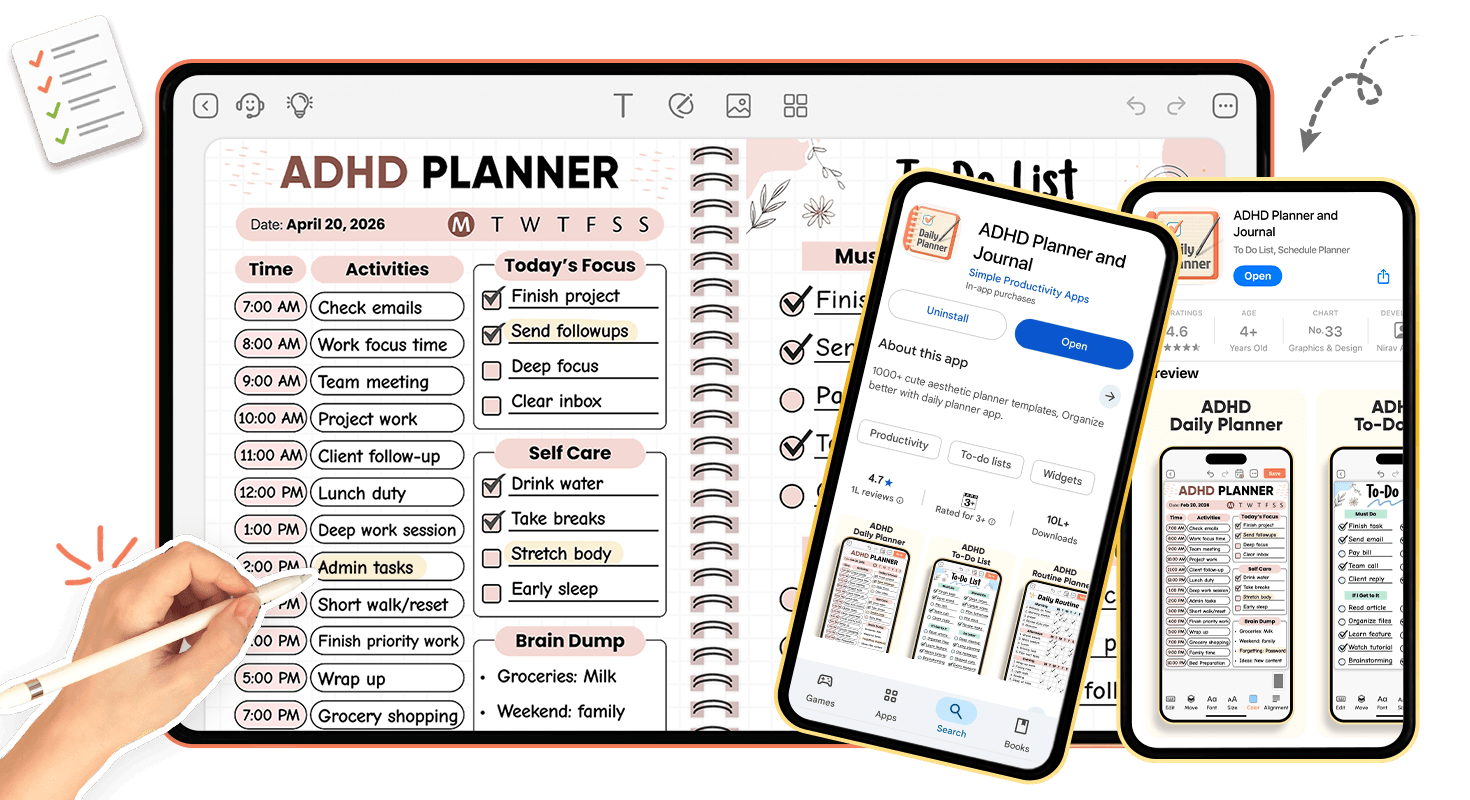
What Is the Best ADHD Planner App in 2026?
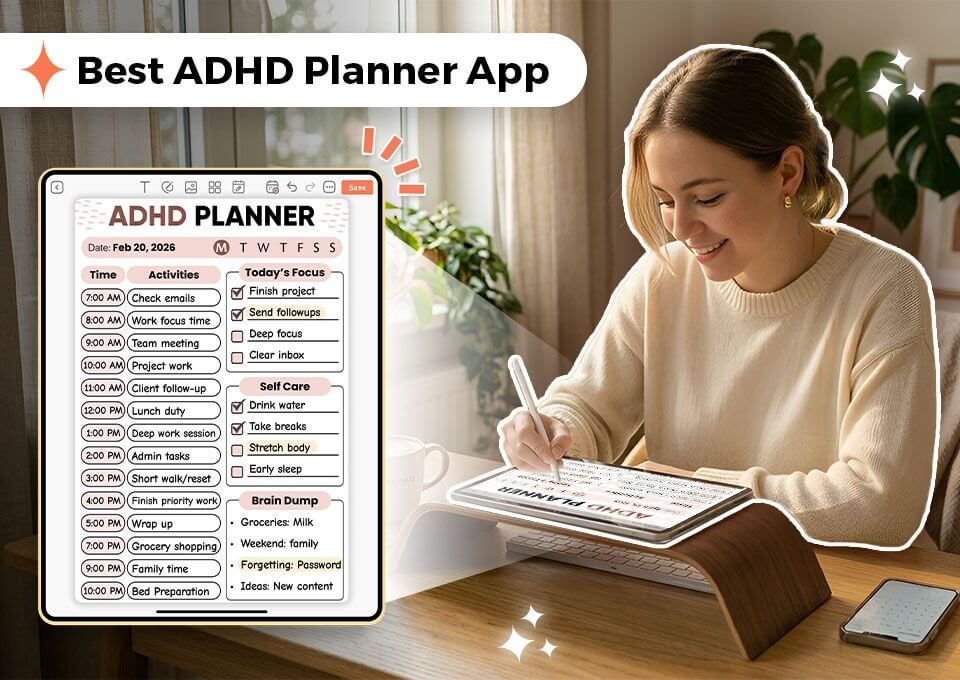
If you're tired of tools that demand more from your brain than they give back, this is for you.
Effective ADHD daily planning shouldn't require hours of setup or mental energy just to begin. The best planner for ADHD should:
- Reduce overwhelm, not pile on more features to figure out
- Remove decision fatigue with ready-made, structured templates
- Adapt to inconsistent energy levels without guilt
- Help you start immediately, without setup paralysis
PlanWiz gives you 1,000+ customizable templates so you spend less time building a system and more time actually using one.
Who Is This ADHD Planner App For?
Built for real ADHD struggles, not productivity fantasies.ADHD Adults
Adults who need a reliable planner for ADHD adults without the rigid schedules that never last.
Students
Students who start strong every semester but lose momentum by week three.
Working Professionals
Recently diagnosed who need a system that fits real life, not a productivity fantasy.
The Frustrated
Anyone frustrated with poor ADHD task management and looking for a simpler way to start and stay on track.
Flexible Thinkers
People who want flexible ADHD productivity tools that don't require willpower to maintain.
Why Does Every ADHD Planner App Leave You Feeling Like a Failure?
Most productivity advice assumes your brain works the same way as everyone else's. It doesn't. And no amount of colour-coded spreadsheets will change that. Here's what ADHD actually looks like, not in a textbook, but in a real day.
Task Paralysis
You open the list. You know what needs doing. You even know which thing matters most. And yet nothing happens...
You close the app. Open it again. Add a task you already finished, just to feel something.
Then somehow
forty minutes pass, and you're watching a video about vintage trains.
This is not laziness. This is task paralysis, one of the most common and least talked-about
symptoms of
ADHD. Your brain's executive function system, the part responsible for deciding when and how
to begin,
runs differently with ADHD. When a list has twenty items, all screaming for attention at
once, it
doesn't
prioritise; it shuts down.
The problem is rarely motivation. It's the blank page. The pre-structured
daily planner
templates
remove that empty-screen decision entirely so your brain can skip the "where do I even
start" spiral and
move straight to doing.
Overwhelm
ADHD has a complicated relationship with time. Neurologically, there are only two time zones: right now and not right now...
So when you sit down to plan your day, you're not just looking at today. You're carrying
last week's
unfinished tasks, the email you forgot to send, the appointment you still haven't booked,
the vague
dread
that you've definitely forgotten something important, all of it compressed into the same
frantic
present.
Standard planners dump everything onto one screen and call it "organised." For an ADHD
brain, that's not
organisation. That's a visual list of everything you should already have done, which is
exactly what
triggers shutdown before you even begin.
The focused
daily
schedule planner
templates
break that wall of overwhelm into one structured, manageable day, nothing more.
Lost Focus
ADHD isn't an attention deficit. It's an attention regulation problem. Some days you can't focus on anything at all...
Other days, you hyperfocus so completely on one thing, often the wrong thing, that four
hours evaporate
and the actual deadline has quietly passed. Both leave you exhausted. Both make planning
nearly
impossible.
Most planners assume that if you write "2 pm: write report," you'll simply be in the mood to
write a
report at 2 pm. That's not how ADHD focus works.
What actually helps is
productivity planner
templates
that structure your session before it starts, so when focus shows up, there's already a
clear path
waiting
for it.
Inconsistency
Some days you're unstoppable. Then there are the other days when getting off the sofa takes ninety minutes...
and the simplest task feels genuinely impossible. Inconsistency is a documented neurological
feature of
ADHD. Your dopamine system doesn't fire predictably.
Any tool that expects the same output from you every single day was built to fail as a
planner for ADHD
adults.
What you actually need are flexible
routine planner
templates,
one that supports you on high-energy days and doesn't punish you when a hard day hits.
"You open the list. You know what needs doing. You even know which thing matters most. And yet nothing happens."
Why Does Your Brain Freeze Even When an ADHD Planner App Tells You What to Do?
This is not a willpower problem. This is not a motivation problem. This is the ADHD executive function system operating under pressure and shutting down. When a list has too many items with no clear entry point, the prefrontal cortex, the part of the brain responsible for deciding what to do and when to start, goes into avoidance mode. The freeze isn't a character flaw. It's a neurological response to decision overload.
The neuroscience: The ADHD brain's prefrontal cortex struggles to prioritise under pressure. Removing the prioritisation task entirely by starting from a ready-made template rather than a blank page bypasses the freeze response and activates action instead of avoidance. This is exactly what PlanWiz was designed to do.
How Does a Good ADHD Planner App Know When You Need Less, Not More?
The biggest reason ADHD planners fail is that they give you too many choices and too much space. A blank planner page for an ADHD brain is not freedom it's paralysis dressed up as flexibility.
PlanWiz solves this with 1000+ ready-made templates across every life category. You don't start from scratch. You pick a template that fits your day, customise what you need, and start. The structure is already there your brain just has to show up.
On a strong day, open detailed goal planner templates and map your week with full clarity and intention. On a hard day, switch to a minimal daily view with just three priorities, and that's enough. The system bends to your energy. You never have to rebuild it from scratch just because yesterday fell apart.
What Features Should an ADHD Planner App Have?
This isn't a regular productivity app with an ADHD label slapped on it. Structure without rigidity, flexibility without chaos, and a starting point that's always ready before you are.
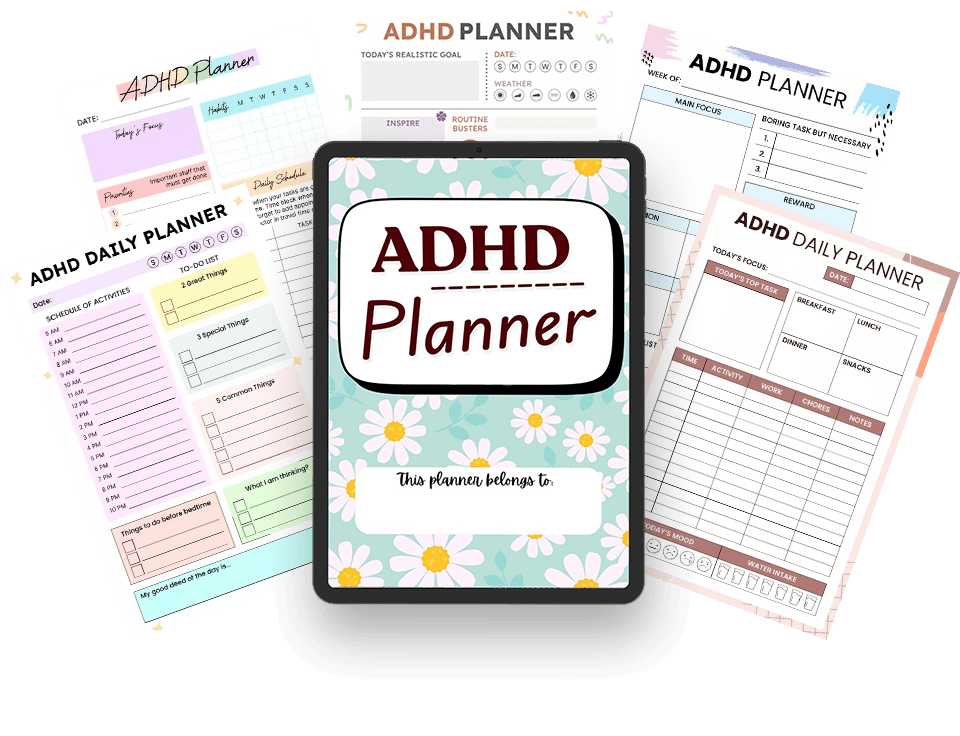
1000+ Ready-Made Templates. No Blank Page. No Paralysis.
When you open the app, you're never staring at an empty screen. Every template arrives pre-structured with sections, prompts, and layouts that guide your brain from the moment you open it.
What's always waiting for you in the weekly planner templates and beyond:
- Focused daily views for single-task clarity
- Full weekly layouts for when you need the bigger picture
- Goal and project templates for longer planning sessions
- Minimal three-priority pages for days when less is everything
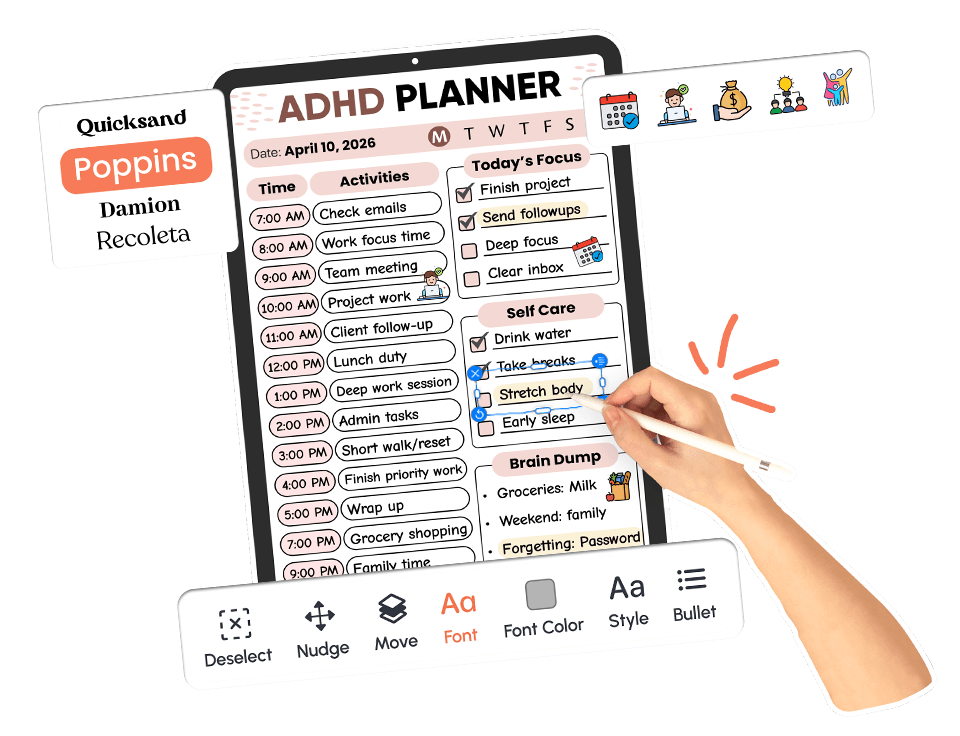
Fully Customizable. Adapts to Your Energy Every Single Day.
ADHD energy doesn't follow a neat 9-to-5 pattern. Some mornings you wake up sharp. Some afternoons, you can't form a coherent sentence, no matter how much coffee you've had. How customization works across every routine planner:
- Change layout, sections, colours, and fonts in minutes, not hours
- Go detailed on high-energy days; strip back to essentials on hard ones
- No fixed format, no guilt for choosing the simpler page today
- Your plan bends to you, never the other way around
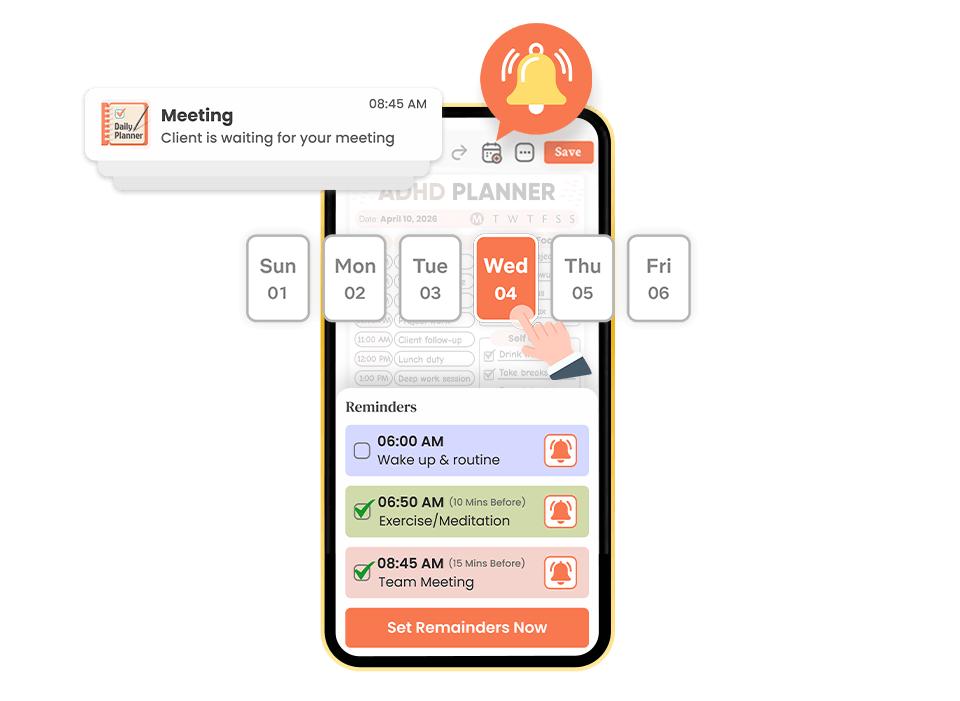
Smart Reminders. Show Up to Your Plan Without Relying on Memory.
For ADHD brains, out of sight genuinely means out of mind. You can build the perfect plan and still miss everything on it, not because you didn't care, but because ADHD time management doesn't come built-in. How reminders work inside your hourly planner templates:
- Set reminders directly on individual tasks and habit check-ins
- Reminders sit right beside the task they belong to, no context-switching
- Use planning session reminders to protect time you'd otherwise skip
- Get nudged back into your day without losing context
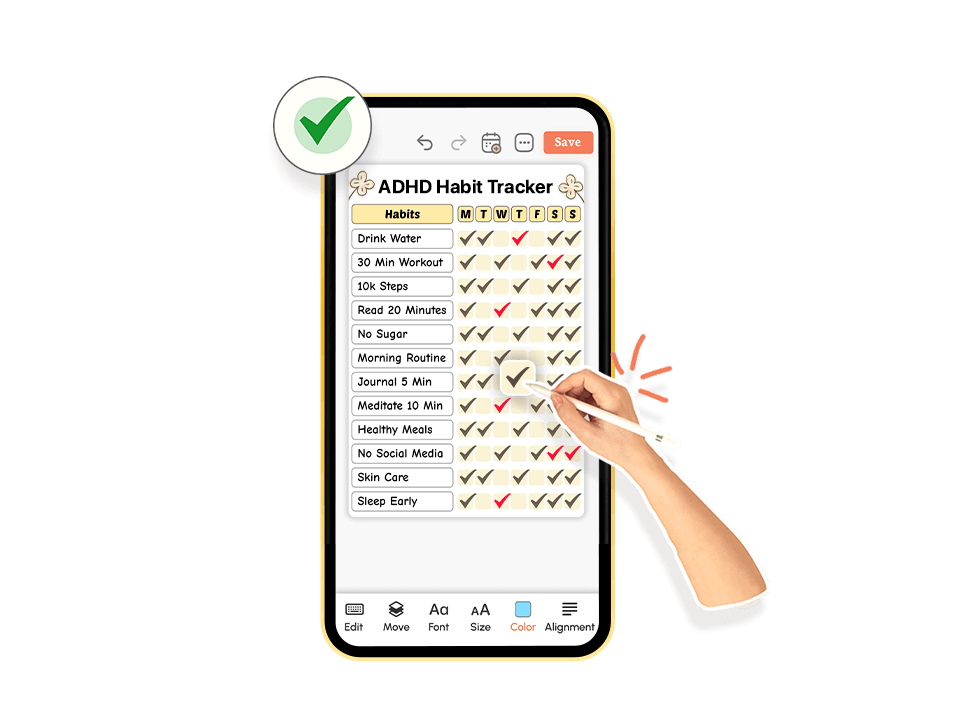
ADHD Habit Tracking Built In. Build Routines That Actually Stick.
Building consistent routines is one of the hardest things for any planner for adults with ADHD, not because people with ADHD don't want consistency, but because most habit trackers are punishing by design. What makes the habit tracker planner templates different:
- Visual, simple habit tracker templates with no shame built in
- Missing a day doesn't reset progress or trigger red badges
- Progress is shown as direction, not a fragile streak to protect
- Skip a day, open tomorrow's page, and keep going without guilt
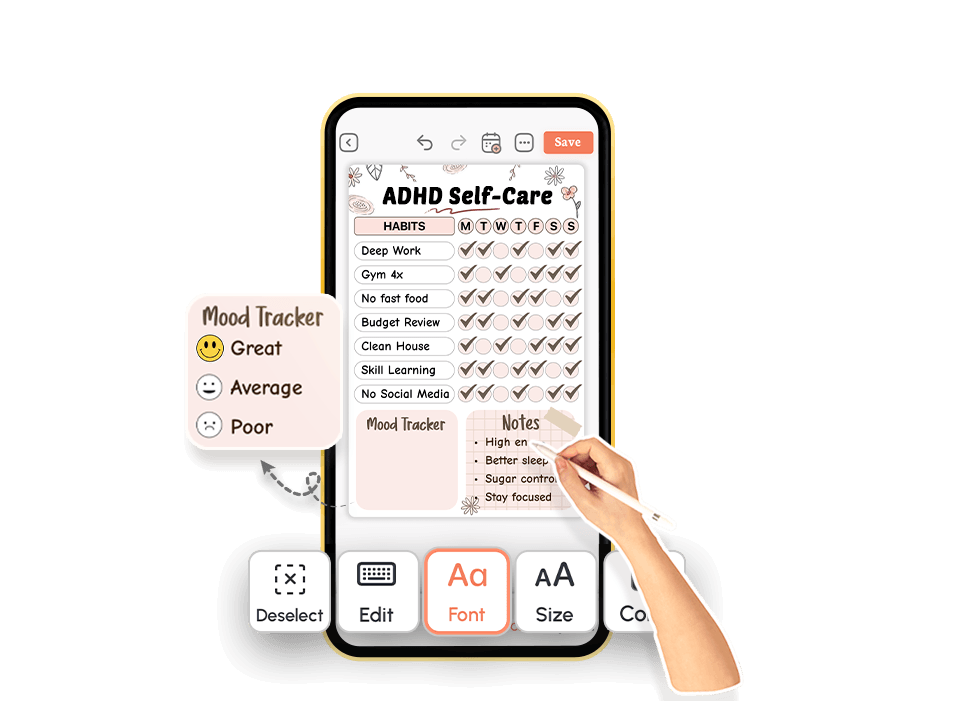
ADHD Self-Care Planning. Because ADHD Takes a Real Emotional Toll.
Living with ADHD is not just a productivity challenge; it's an emotional one. The guilt of missed tasks, the frustration of lost focus, the exhaustion of constantly fighting your own brain, it compounds quietly until even small tasks feel impossible. What's included in the self-care planner templates:
- Dedicated self-care pages alongside your task and goal templates
- Space to track rest, mood, and emotional load, not just output
- Recovery planning is built into the same system as work planning
- A format that treats your well-being as non-negotiable, not an afterthought
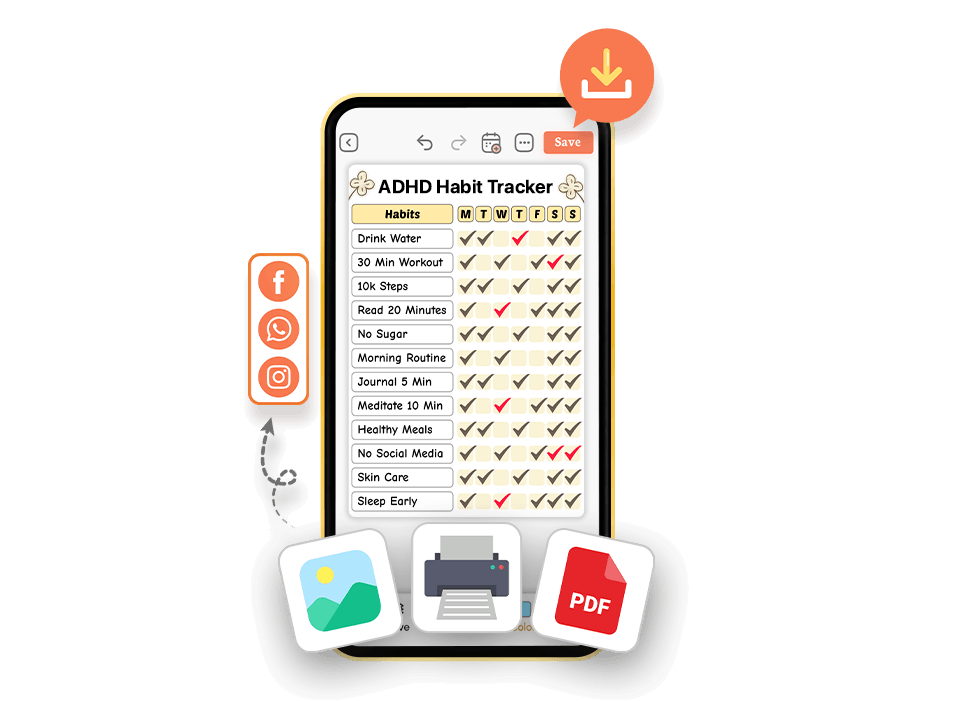
Download and Share. Build Accountability Without Extra Effort.
A plan that lives only in an app is one missed notification away from disappearing. Sharing your plan is one of the most research-backed strategies for ADHD task management, and Planwiz makes it completely frictionless with easy productivity planner templates you can share with one tap.
- Download any planner page as a PDF to save, print, or file
- Share your weekly plan with a partner, coach, or therapist with one tap
- Print a daily page and place it somewhere you'll actually see it
- Send your habit tracker to your ADHD coach without retyping anything
Explore ADHD Planner Templates That Work for Your Brain
Pick the Template That Matches Your DayEvery template is pre-structured so your brain never faces a blank page. Browse below and tap any template to explore it.
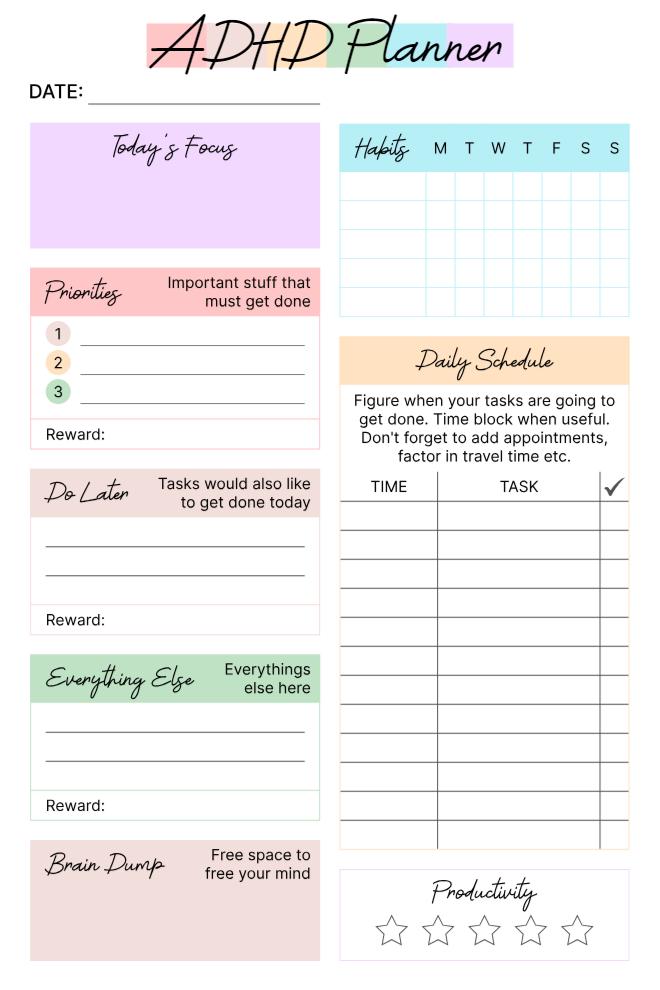
ADHD Daily Planner
This planner gets how ADHD brains actually work. Instead of one giant to-do list that feels overwhelming, it breaks things into chunks that make sense. You've got your main focus for the day, a habit tracker across the week, and your top three priorities with space for a reward when you finish them.
The "Do Later" section is genius for those thoughts that pop up when you're trying to focus on something else. There's also an "Everything Else" catch-all, a brain dump area for random thoughts, and a daily schedule that reminds you to actually time-block your tasks. The productivity star rating at the bottom helps you track patterns without judgment.
Use This Template →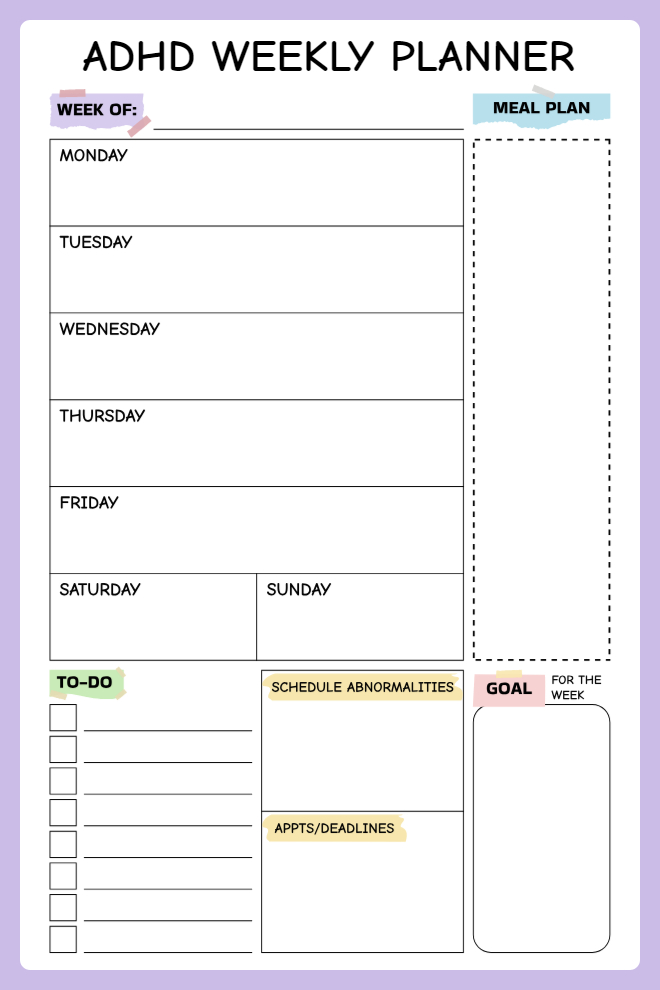
ADHD Weekly Planner
This weekly layout keeps everything visible without cramming too much onto one page. Each weekday gets its own box, with Saturday and Sunday sharing space since weekends often blur together anyway. The meal plan section on the side is super practical because decision fatigue is real.
What really sets this apart are the "Schedule Abnormalities" and "Appointments/Deadlines" boxes perfect for noting the things that might derail your routine so you're not caught off guard. The to-do list and weekly goal section help you stay focused on what actually matters.
Use This Template →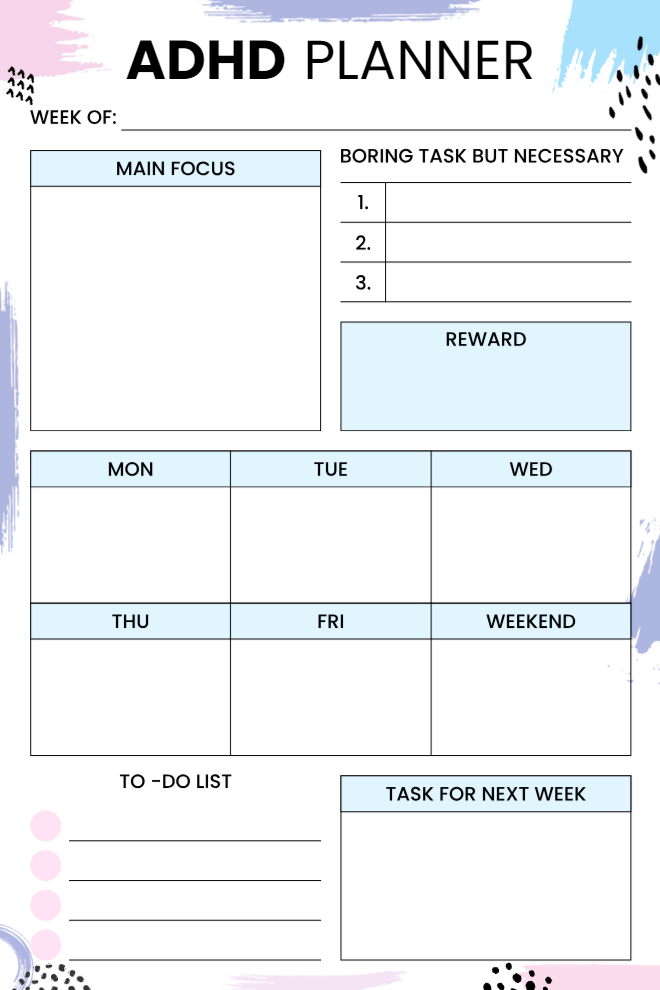
ADHD Weekly Focus Planner
Here's a planner that actually acknowledges boring tasks exist and still need to get done. The "Main Focus" box keeps you centered on what really matters this week, while "Boring Task But Necessary" gives those annoying-but-important tasks their own spotlight. Each gets a reward section because external motivation helps.
The week is laid out Monday through weekend with decent space for each day, plus a to-do list on the side and a forward-planning section for next week. The artistic paint strokes around the edges make it feel less corporate and more personal.
Use This Template →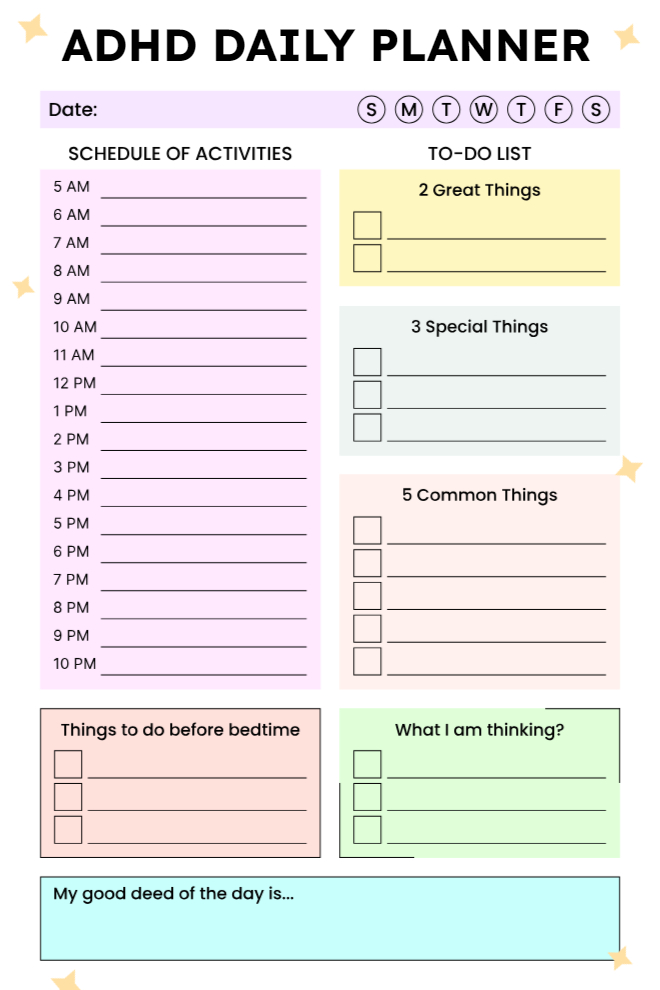
ADHD Daily Priority Planner
This planner uses a smart prioritization system that actually works with how ADHD brains categorize importance. Instead of numbering tasks 1–10 (which feels arbitrary), it breaks your to-do list into "2 Great Things," "3 Special Things," and "5 Common Things." That makes it way easier to figure out what deserves your best energy.
The hourly schedule runs from 5 AM to 10 PM, the bedtime routine checklist helps with that transition struggle, and there's a "What I am thinking?" box for brain dumps. The "good deed of the day" section adds a positive reflection element that's actually meaningful.
Use This Template →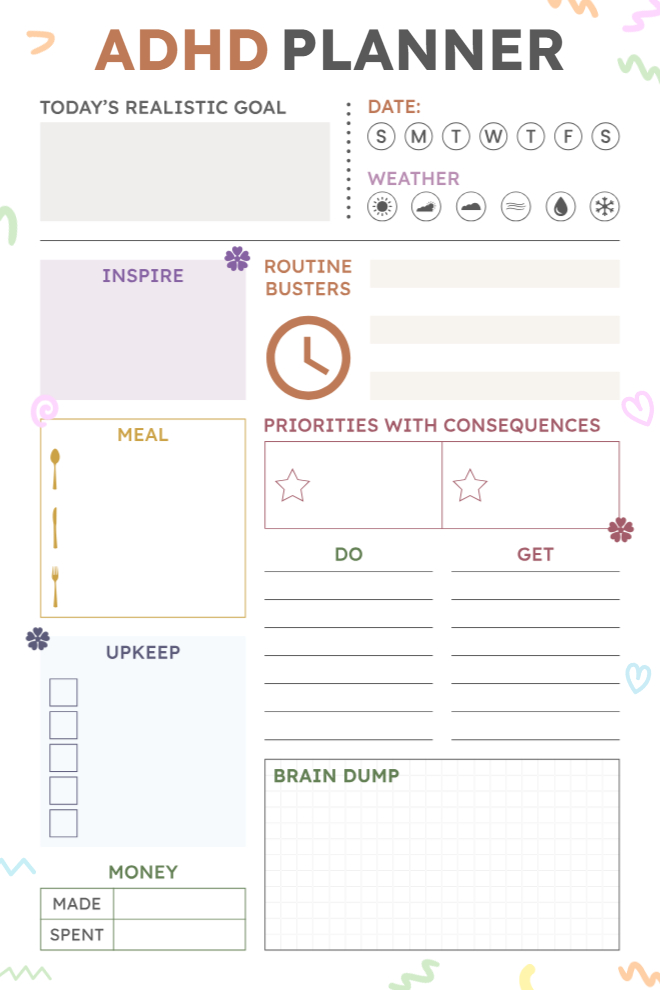
ADHD Comprehensive Daily Planner
This planner packs in a lot without feeling chaotic. It starts with a realistic goal (not an impossible dream list), has weather icons so you remember to check before leaving the house, and includes an "Inspire" box for motivation. The "Routine Busters" section acknowledges that unexpected things will happen, while the meal planner prevents the 6 PM "what's for dinner" panic.
The "Priorities with Consequences" table is brilliant it shows what you'll DO and what you'll GET, making cause-and-effect crystal clear. You've also got an upkeep checklist for maintenance tasks, a money tracker, and a big brain dump space for clearing mental clutter.
Use This Template →Why Does the Best ADHD Planner App Not Punish You for the Days You Fall Apart?
In most planners, a missed task turns red. Overdue items pile up. Notification badges accumulate like a ledger of your failures. And every time you open the app, you're greeted with a visual summary of everything you didn't do.
For an ADHD brain, that's not accountability. That's a shame spiral waiting to happen.
Shame is one of the most common triggers for a complete productivity shutdown in people with ADHD. The thought pattern goes: "I've already messed up, so why bother trying to recover today?" And an entire week can unravel from a single hard Tuesday.
This isn't lowering the bar. It's removing a psychological obstacle that was never helping you clear it in the first place.
"Today is a new day. Here's your structure. You've still got this."
With PlanWiz, you simply open a fresh template tomorrow. No red badges. No overdue pile. No guilt. Just a clean, ready-to-use layout.
How Do You Actually Get Started With PlanWiz?
No complicated setup. No reading documentation. No building the perfect system before you're allowed to use it.
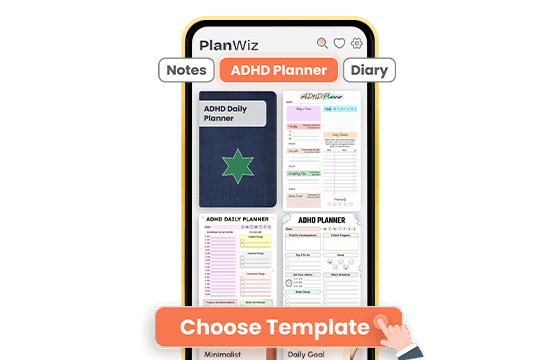
Choose a Template That Fits Your Day
Browse from 1000+ ready-made templates and pick one that matches your energy. Feeling ambitious? Go detailed. Surviving today? Pick something simple with three sections. Either way, the structure is already there; you're not starting from zero.
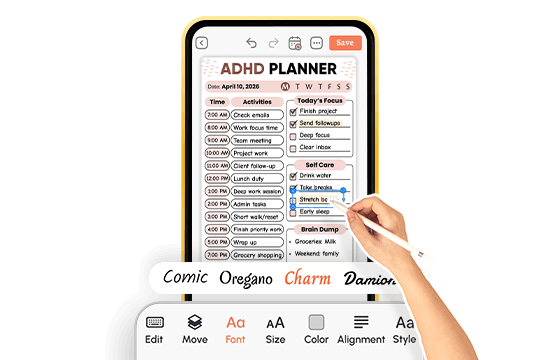
Customize in Minutes
Add your tasks, adjust sections, change colours or fonts if you like. Or use the template exactly as it is. Either way, you're planning within minutes, not after an hour of setup that drains the motivation you had left.
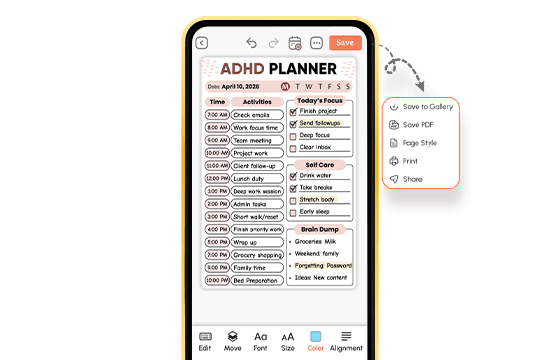
Plan, Track, and Move Forward
Write your tasks, track your habits, and note what matters. When a hard day hits, switch to a simpler template. When you miss a day, open a fresh one tomorrow. No guilt. No starting over. Just forward one page at a time.
That's the whole system.
What Do Real People With ADHD Say About This Planner App?
From people who've already tried everything else.
Ready to Try the ADHD Planner App That Works With Your Brain, Not Against It?
If something on this page felt familiar, you're exactly who this was built for. Not a productivity app with an ADHD label stuck on top, a planner built for how your brain actually works.
Free to start. No credit card. Ready in under three minutes.
Start Free → PlanWiz.app

Frequently Asked Questions
The best planner for ADHD is one that reduces overwhelm, removes decision fatigue, and gives your brain a clear starting point every single day with 1,000+ pre-built templates so you never face a blank page again.
A planner designed for ADHD is built around executive dysfunction, time blindness, and inconsistent energy levels. Unlike regular planners that hand you blank pages and expect you to build the structure yourself, this app gives you pre-structured templates that remove decision fatigue before you even begin.
A good planner for ADHD adults should include ready-made templates to eliminate blank-page paralysis, full customization to adapt to different energy levels, built-in reminders to manage time blindness, flexible habit tracking, and a simple way to download or share accountability plans.
Yes, significantly. The right ADHD productivity tools reduce the decision fatigue of "how do I even set this up today" making it much easier to start and follow through. The key is choosing tools built specifically around ADHD needs, not general productivity apps with an ADHD mode bolted on.
Start from a pre-built structure, not a blank page. Pick a simple template, write your top three tasks, and keep it minimal. Set a reminder so you return to your plan during the day. On hard days, reduce rather than abandon. On strong days, go deeper. The goal is a consistent direction, not a perfect streak.
ADHD time management is difficult because the ADHD brain doesn't perceive time the way neurotypical brains do. There's "right now" and "not right now" which makes future planning feel abstract and easy to ignore. Built-in reminders and pre-structured daily layouts bridge that gap, giving your brain the external cues it needs to stay anchored to the plan.